
Google's February 2026 Discover Update: What Publishers Need to Know Right Now
The Update That Changed Everything
Something unprecedented happened on February 5, 2026. Google rolled out its first-ever core algorithm update designed exclusively for the Discover feed — completely separate from traditional search rankings. Named the February 2026 Discover Core Update, this change is already reshaping how millions of publishers drive traffic.
If you have noticed your Discover traffic plummeting in recent days, you are experiencing this shift firsthand. According to Google's official announcement, this update aims to make Discover "more useful and worthwhile" by fundamentally changing how content gets selected and ranked in the feed.
This guide breaks down what happened, identifies why your traffic may be affected, and provides clear, actionable strategies to recover and grow your Discover visibility moving forward.
Understanding the February 2026 Discover Update
Key Facts at a Glance:
Launch Date: February 5, 2026
Initial Coverage: US-based English-language users only
Rollout Time: Up to two weeks
Geographic Expansion: Planned for all countries and languages
Impact Scope: Exclusively affects Google Discover, not Search results
What is Google Discover?
Google Discover is the personalized content feed visible when users open the Google app or visit google.com through Chrome. Unlike traditional search where users actively enter queries, Discover proactively surfaces articles based on individual interests, browsing history, and location patterns.
According to Search Engine Roundtable's Barry Schwartz, this marks the first instance of Google announcing a core update targeting only Discover — a significant development indicating that Google now manages Discover's quality standards independently from Search.
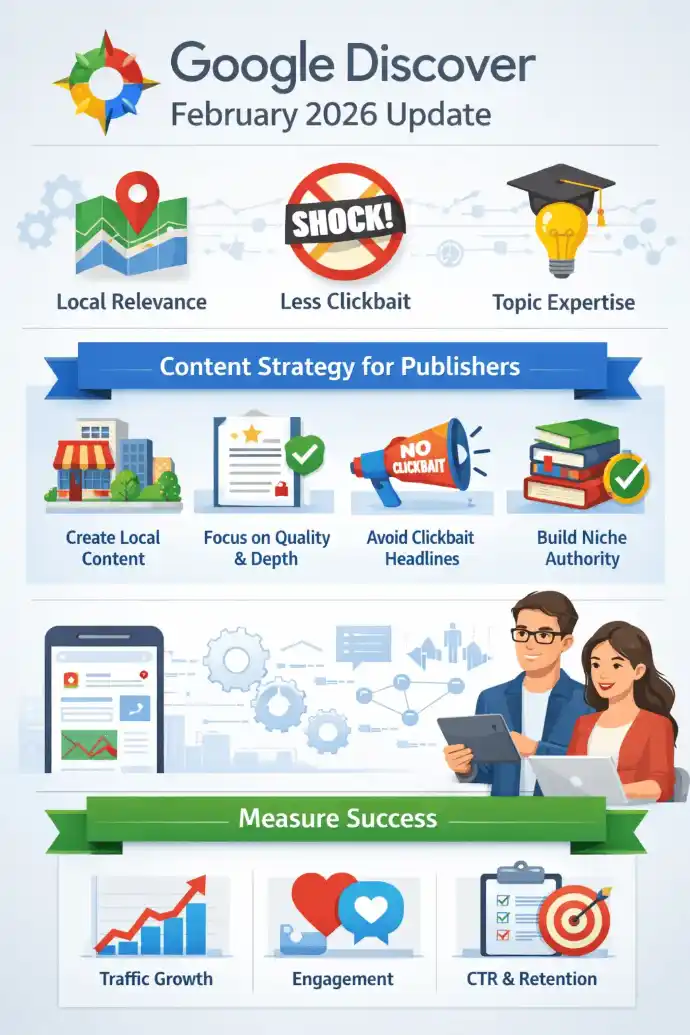
Three Fundamental Changes Publishers Must Understand
1. Geographic Relevance Now Drives Visibility
The update prioritizes showing users content from websites based in their own country. This represents a major shift in how Discover distributes international content.
Practical Impact:
American readers will predominantly see content from US-based publishers
When the update reaches India, Indian readers will see more locally-published content
International publishers who previously captured foreign traffic may experience temporary decreases
Real-World Scenario:
Consider a Canadian tech publisher that previously received 40% of their Discover traffic from US audiences. Post-update, that figure dropped to 15% as Google began favoring American tech sites for American readers. However, once the update launches in Canada, this publisher should see substantial gains in Canadian readership.
2. Sensationalism Gets Demoted
Google is actively reducing content that relies on manipulative tactics to generate clicks. The system now better identifies and penalizes several specific patterns:
Headlines that misrepresent or exaggerate actual content
Titles intentionally withholding information to create artificial curiosity
Thumbnail images or preview text that does not match the article
Language designed purely for emotional manipulation or shock value
The Shift in Headlines:
Problematic: "You Won't Believe What This CEO Revealed About AI!"
Effective: "Google CEO Announces New AI Search Features Launching March 2026"
The first example manipulates curiosity without providing information. The second delivers clear, accurate value upfront. Google's systems now recognize and reward this distinction.
3. Expertise Gets Evaluated Topic by Topic
Here is where things get interesting. Google no longer evaluates authority at the domain level alone. Instead, it assesses expertise for each individual subject area your site covers.
A local news website that publishes a comprehensive gardening section can establish clear expertise in gardening topics, even while covering general news. Conversely, a movie review site publishing a single gardening article will not be recognized as knowledgeable in that field.
This topic-specific evaluation creates opportunities for both niche specialists and broader publishers with dedicated subject experts.
Diagnosing Why Your Traffic Dropped
Issue 1: Prioritizing Clicks Over Genuine Reader Value
Many publishers built their Discover presence using tactics that no longer work:
Headlines designed to trigger curiosity without delivering substance
Surface-level coverage of trending topics without unique insights
Brief articles that simply repackage existing content
Emotional manipulation to drive engagement metrics
Google's artificial intelligence has evolved to distinguish between content engineered for clicks versus content created to genuinely help readers. The update significantly shortened how long clickbait content remains visible in Discover.
Warning Signs:
Articles experience brief traffic spikes before disappearing entirely
High click-through rates paired with extremely low time-on-page
Readers immediately bouncing back after opening your content
Sharp increases in bounce rate since early February
Minimal social sharing despite temporary traffic gains
Critical Question: When readers see your headline and then read your article, do they feel informed or misled?
Issue 2: Lack of Clear Topical Focus
Publishing across scattered, unrelated trending topics prevents Google from identifying what you actually specialize in.
Two Contrasting Approaches:
Scattered Strategy (Ineffective): Sarah manages a health blog. Last month she published articles covering celebrity news, smartphone features, cryptocurrency basics, weight management, and fashion trends. Google cannot determine her area of expertise.
Focused Strategy (Effective): John exclusively publishes diabetes management content — three detailed, research-backed articles weekly. Google clearly identifies John as a diabetes specialist.
Additional Indicators:
Content spans numerous topics without depth in any specific area
Frequent niche-hopping chasing different trends monthly
Readers uncertain about your site's core value proposition
Weak internal linking due to topic fragmentation
No recognizable editorial specialty or unique angle
Issue 3: Geographic Targeting Misalignment
The update's geographic prioritization particularly affects international publishers who previously attracted substantial US traffic.
Example Scenario:
A UK technology publisher was capturing 40% of Discover traffic from American readers. Post-update, that percentage fell to 15% as Google began prioritizing US-based technology publishers for American audiences. Once the update reaches the UK, this publisher should see significant increases in British readership.
Related Symptoms:
Sudden international traffic declines while domestic traffic remains stable
Content optimized for one geographic market being consumed primarily in another
Revenue impact if monetization relied on international audience scale
Analytics revealing unexpected country-level traffic pattern shifts
Content strategy now misaligned with actual reader locations
Issue 4: Headlines That Overpromise and Underdeliver
Google actively compares what headlines promise against what articles actually provide — and penalizes significant gaps.
Failed Pattern:
Headline: "The Secret Marketing System Top Experts Use for Explosive Growth"
Content: Generic beginner-level marketing tips available everywhere
Successful Pattern:
Headline: "5 Email Marketing Tactics That Increased Our Sales 127% — Complete Data Breakdown"
Content: Detailed tactical explanations with campaign screenshots, actual metrics, and replicable processes
Additional Red Flags:
Readers clicking through then immediately exiting frustrated
Declining trust and brand perception among your audience
Google detecting poor engagement signals like minimal scroll depth
Month-over-month decreases in repeat visitor rates
Minimal content bookmarking or saving behavior
Proven Recovery Strategies That Work
Strategy 1: Establish and Maintain Topical Focus
This represents the single most impactful change publishers can make immediately.
Implementation Framework:
Phase 1 — Define Your Authority Areas
Identify two or three specific subjects where you possess genuine expertise through personal experience, professional background, or hands-on knowledge. Avoid broad categories like "technology" — instead, choose precise niches like "project management tools for remote teams" or "conversion optimization for SaaS companies."
Phase 2 — Build Consistent Publishing Rhythm
Commit to publishing two to three focused articles weekly within your chosen topics. Plan content three to six months ahead, balancing evergreen material with timely updates. Publishing consistency signals sustained expertise rather than opportunistic content creation.
Phase 3 — Create Substantive Content
Target 1,500 to 2,500 words per article. Include step-by-step guidance, original screenshots, practical examples, and downloadable resources when applicable.
Real Transformation Case:
A food blogger previously published scattered content — Italian recipes, then diet trends, then restaurant reviews, then kitchen equipment comparisons. Traffic remained inconsistent with sporadic Discover appearances.
She refocused entirely on Indian vegetarian cooking, publishing three detailed recipes weekly with precise timing, ingredient measurements, personal variations, common mistake warnings, and nutritional analysis.
Three-Month Results:
Established clear topical authority in Indian vegetarian cuisine
Discover traffic increased 340%
Built engaged audience anticipating each new recipe
Google consistently surfaced her content to interested readers
Received food brand partnership opportunities
Grew email list to 5,000+ active subscribers
Google tracks publishing patterns over time. Sustained, high-quality output in specific areas builds "topical authority" — exactly what this update rewards.
Strategy 2: Craft Informative Headlines, Not Manipulative Ones
Effective headlines communicate clear value without tricks or exaggeration.
Essential Elements:
Specific metrics: Concrete numbers like "7 Methods" or "143% Growth" build credibility
Clear outcomes: Tell readers exactly what they will learn or achieve
Honest accuracy: Deliver precisely what the headline promises
Eliminate These Patterns:
"You won't believe..." phrasing
Deliberately withholding core information to force clicks
Unverifiable or inflated claims
Excessive punctuation or ALL CAPS formatting
Manipulation language: shocking, secret, unbelievable
Headline Transformations:
Subject | Ineffective Approach | Effective Approach |
Technology | "This AI Tool Will Blow Your Mind 🤯" | "Claude 4 Launches With 200K Context Window and Enhanced Coding" |
Health | "Doctors Hate This Simple Weight Loss Trick" | "How Intermittent Fasting Helped Me Lose 30 Pounds Over 6 Months (Physician-Approved)" |
Business | "The Secret Every Millionaire Knows But Won't Share" | "Warren Buffett's 5 Core Investment Principles from His 2026 Letter" |
Personal Finance | "You're Making These Money Mistakes — Fix Now!" | "5 Budgeting Errors That Cost Me $12,000 and Exactly How I Corrected Them" |
Pre-Publication Checklist:
Does this headline accurately represent the article content?
Would I share this headline with subject matter experts without embarrassment?
Does it provide information or just extract clicks?
Any hesitation means the headline needs revision.
Strategy 3: Add Value That Cannot Be Replicated
Google prioritizes content that contributes genuinely new information rather than rephrasing existing material.
Four Value-Creation Methods:
1. Document First-Hand Experience With Specific Data
Instead of stating "email marketing drives sales," share exactly what happened when you implemented it.
Example: "I tested four email automation sequences for my consulting business over 90 days. The welcome series generated 23 new clients and $87,000 revenue. The abandoned cart sequence recovered 18% of lost sales. Here is precisely what I built, the results I measured, and why certain approaches outperformed others..."
This specific, documented experience cannot be copied because it is rooted in unique reality.
2. Conduct Original Research
Run surveys among your audience, analyze data you have collected, or document controlled experiments. Original data powerfully signals genuine expertise.
3. Feature Expert Interviews
Contact specialists in your field through LinkedIn, prepare thoughtful questions, and incorporate their insights with proper attribution. This adds authority and perspective that generic content lacks.
4. Create Custom Visual Content
Develop annotated screenshots, process diagrams, comparison tables from your testing, or video walkthroughs of actual workflows. Self-created visuals signal originality to both readers and Google's evaluation systems.
Notable Case Study:
Mike, a fitness blogger, plateaued at 2,000 monthly Discover visitors publishing generic workout advice readily available elsewhere.
He completely changed approach over four months, documenting his entire fitness journey: weekly progress photographs, precise body measurements, detailed meal plans with calorie breakdowns, gym videos demonstrating proper form, candid monthly reports including setbacks, supplement reviews with purchase receipts, and transparent budget tracking of every health expense.
Four-Month Outcomes:
Discover traffic: 2,000 → 34,000 monthly visitors
Email subscribers: 0 → 12,000
Brand partnerships: 7 paid collaborations
Digital product revenue: ₹2.3 lakh from e-book sales
YouTube growth: 25,000 subscribers
Instagram expansion: 45,000 engaged followers
His content became impossible to replicate because it emerged entirely from lived experience. Readers trusted it because they witnessed his authentic journey in real time.
Strategy 4: Build Structured Content Ecosystems
Since Google evaluates expertise per topic rather than per entire domain, construct organized content clusters instead of isolated articles.
Content Cluster Architecture:
Begin with one comprehensive pillar article per main topic: 3,000-5,000 words covering beginner through advanced levels, linking to 10-15 supporting articles.
Then develop supporting content — each article addressing a specific subtopic, all interconnecting with the pillar and each other.
Digital Marketing Blog Example:
Pillar: "Complete Email Marketing Guide for 2026" (4,500 words)
Supporting Articles:
- "Building Email Lists from Zero to 10,000 Subscribers"
- "Email Subject Lines That Achieve 40%+ Open Rates"
- "Email Automation Workflows: Complete Setup Guide"
- "A/B Testing Methodology for Email Campaigns"
- "GDPR Compliance: Email Marketing Checklist"
These interconnected articles reinforce topical authority, signaling genuine expertise rather than isolated one-off content.
Author Credibility Requirements:
Every specialist author needs detailed biographies including: years of relevant experience, specific qualifications, measurable achievements, publication history or speaking engagements, and professional profile links. This directly supports Google's E-E-A-T (Experience, Expertise, Authoritativeness, Trustworthiness) evaluation framework.
Strategy 5: Optimize for Geographic Relevance
According to Google's official guidance, website owners should use headlines that accurately capture content essence, avoid clickbait tactics, and employ high-quality images at least 1,200 pixels wide with max-image-preview:large enabled.
Beyond technical requirements, geographic relevance now directly impacts Discover visibility.
Location Signal Integration:
Homepage Elements: Clearly display your country or city, include local contact numbers, show physical address, implement local business schema markup.
Author Biographies: State each author's location and highlight market-specific experience.
Content Strategy: Reference local examples, discuss regional regulations and events, mention local companies, use appropriate currency and measurements. For Indian audiences: ₹ not $, GST not VAT, examples from Indian businesses and culture.
Topic Localization Example:
Generic: "Best E-Commerce Platforms for Small Businesses"
Top E-Commerce Platforms for Indian Sellers in 2026: A Practical Comparison of UPI Payment Support, GST Compliance Features, Shiprocket Integration, and Native INR Billing
The localized version addresses specific Indian seller needs. Google now actively rewards this geographic precision.
Recovery Timeline Expectations
Core updates create traffic fluctuations. Some sites gain visibility, others lose it, and many experience no change.
Realistic Timeline:
Weeks 1-2 (Feb 5-19): Active US rollout. Fluctuations are normal. Avoid panic or premature strategy overhauls.
Weeks 3-4: Effects stabilize. Optimal time to analyze which content gained or lost visibility and plan adjustments accordingly.
Months 2-6: Global expansion begins. Non-US publishers may see local market recovery as update reaches their regions.
Key Principle: Wait at least two weeks post-rollout before making significant strategic changes.
Building Future-Proof Content
Rather than reacting to each algorithm change, create content that maintains value regardless of future updates.
Three Enduring Principles:
1. Prioritize Readers Over Algorithms
“If Google no longer existed tomorrow, would this content still hold real value for my audience?”
If not, complete rewrite needed.
2. Develop Expertise That Requires Time
Content requiring genuine experience, testing, and learning creates sustainable competitive advantages that algorithms cannot erase.
3. Create What AI Cannot Reproduce
Your specific results, authentic failures, original data, professional relationships, personal photographs, unique voice — these cannot be AI-generated. This represents your real competitive edge.
Information Sources
- Google Search Central Blog — Official update announcement
- Search Engine Land — February 2026 Discover update coverage
- Search Engine Roundtable — Barry Schwartz analysis
- Search Engine Journal — Core update reporting
- Google Discover Help — Official publisher guidance
Our latest content
Check out what's new in our company!